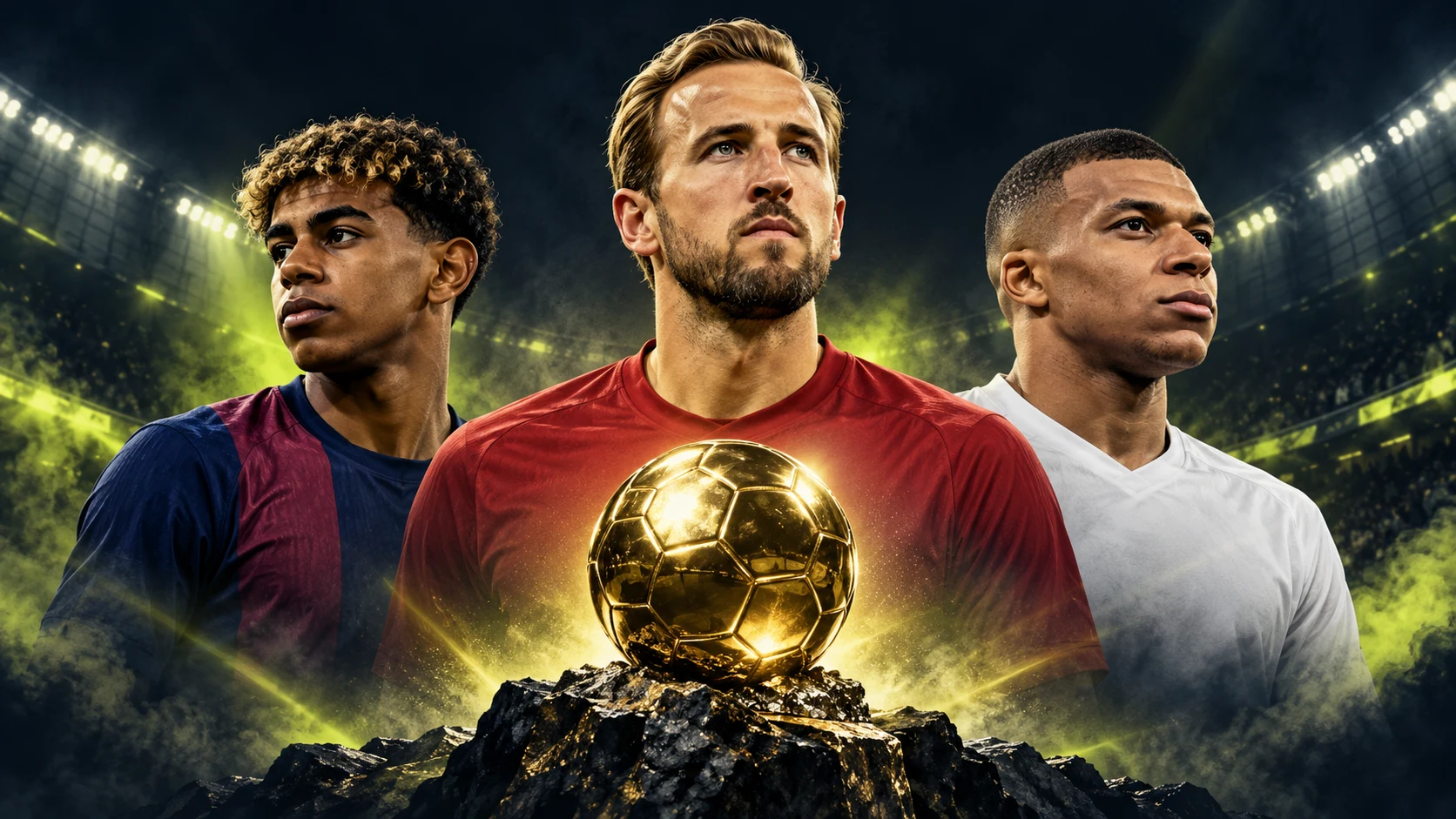
Harry Kane’s goals, Lamine Yamal’s creativity and Kylian Mbappé’s performances on the biggest stages make this a fascinating debate. Here is why Kane finishes first in my rankings.
Winning the Ballon d’Or is hard. Separating the players who deserve it can be just as difficult.
Do you favour the striker who keeps scoring, the winger who makes an entire attack more dangerous, or the player who delivers extraordinary numbers in the biggest competitions? And how much should winning a World Cup decide an individual award?
Those are the questions behind my top three: Harry Kane, Lamine Yamal and Kylian Mbappé.
My choice is Kane. His goals are the starting point, but the argument goes further than the headline total. His contribution to Bayern Munich’s attacking play, the range of competitions in which he delivered and his decisive performance in the German Cup final give him the strongest overall case for me.
That is my verdict on the season, rather than a prediction of how every journalist will vote. Yamal and Mbappé have serious arguments of their own.
What are we actually judging?
The assessment period runs from 3 August 2025 to 19 July 2026, including the World Cup. France Football lists three criteria in order of importance: individual performance and decisiveness; team performance and trophies; then class and fair play. [1]
That order matters. A trophy cabinet strengthens a candidate’s case, but it cannot replace an assessment of what the player personally contributed. Equally, a goals table cannot tell us everything about a winger, midfielder or defender.
I am weighing the full campaign, the player’s role and the moments in which their contribution made a difference. Career reputation, age and what someone might achieve next season should not decide this award.
Why these three?
This is my shortlist, not a claim that only three nominees deserve consideration.
Rodri’s World Cup Golden Ball makes him impossible to dismiss. Michael Olise’s creativity deserves recognition alongside Kane’s finishing, while Ousmane Dembélé has Champions League success in his corner. Their cases expose the difficulty of comparing different roles and different routes to success. [2][3]
My preference is for Kane’s sustained scoring and all-round forward play, Yamal’s combination of creation and winning, and Mbappé’s exceptional scoring in Europe and at the World Cup. I place that trio ahead of the alternatives across the whole assessment period. Readers who value midfield control or a Champions League-winning campaign more heavily may reasonably arrive at a different three.
The numbers at a glance
| Player | Appearances | Goals | Assists | Main point of distinction |
|---|---|---|---|---|
| Harry Kane | 65 | 73 | 8 | Exceptional scoring alongside Bayern’s domestic success |
| Lamine Yamal | 57 | 25 | 20 | Creative influence alongside La Liga and World Cup success |
| Kylian Mbappé | 60 | 58 | 13 | Outstanding scoring in the Champions League and World Cup |
Club and international totals use the Ballon d’Or organiser’s 2026 nominee summaries throughout. This keeps the comparison consistent rather than mixing providers’ appearance and assist definitions. [2]
These figures give us a starting point. They do not measure everything a player does, and the three forwards perform different jobs. Yamal’s lower goal total, for example, is not by itself a reason to rank him below a centre-forward.
Third: Kylian Mbappé — the strongest argument against counting trophies
Real Madrid and France | Forward
Mbappé’s case deserves more than a quick glance at Real Madrid’s silverware.
He scored 15 Champions League goals and 10 at the World Cup, finishing as the leading scorer in both competitions. His World Cup total rose to 22, taking him beyond every other player in the tournament’s history. He also received the tournament’s Bronze Ball. [3][4]
That is an extraordinary combination. It is difficult to argue that a player delivering those numbers has failed to perform on the biggest stages.
What appeals to me about Mbappé is the speed at which he can change a match. A defender can appear comfortable, then one run creates a chance that barely existed a moment earlier. His pace is obvious, but the timing and finishing are what make it so damaging.
The weakness in his case is the overall outcome. Madrid went without a major team trophy, while France finished fourth at the World Cup. Those results matter under the award’s criteria, even though neither can fairly be blamed on one forward. [2][3][4]
I would not rule out a Ballon d’Or winner simply because his team finished empty-handed. Individual performance comes first. Here, however, Kane offers a stronger scoring campaign alongside domestic trophies, while Yamal combines a different kind of attacking influence with success for both club and country.
Of my three decisions, placing Yamal above Mbappé is the closest. Mbappé has the stronger case if you place greatest weight on goals in the Champions League and World Cup. I give Yamal the narrow edge because of the balance between his creative contribution and collective success.
Mbappé takes third, but it is a ranking among exceptional candidates. It should not be mistaken for a disappointing individual season.
Second: Lamine Yamal — a world champion with a case of his own
Barcelona and Spain | Right winger
What can you even say about this lad?
The confidence, the close control and the willingness to take responsibility are remarkable. When Yamal receives the ball wide on the right, he gives defenders several problems at once: protect the outside, stop him coming inside, or follow the teammate whose run he might find.
He helps make chances possible before the final pass is played. That is why comparing his goals directly with Kane’s would miss much of his value.
His season brought La Liga, the Spanish Super Cup and the World Cup, supported by 25 goals and 20 assists in the organiser’s figures. That is a substantial individual contribution alongside an outstanding set of team achievements. [2]
So why do I have him second?
The World Cup strengthens his case, but I do not think Spain’s victory settles the individual comparison. Rodri received the tournament’s Golden Ball. Yamal deserves credit for being part of the winning side, while his personal contribution still needs to be assessed separately from the medal. [3]
His Champions League exit also needs context. Barcelona lost their quarter-final against Atlético Madrid 3–2 on aggregate, but Yamal scored after four minutes in the second leg as Barcelona tried to overturn the deficit. UEFA’s report describes his part in their strong opening. That is evidence of a player taking responsibility, even though his team ultimately went out. [5]
It would therefore be unfair to use that elimination as proof that he does not turn up in important matches. Team failure and individual failure are not the same thing.
My argument for putting Kane ahead is more specific: I give greater weight to the scale of Kane’s scoring across the campaign and his decisive contribution to Bayern’s domestic double. Yamal’s creativity and Spain’s World Cup triumph make this a real debate, but they do not quite overturn that advantage for me.
His age has no bearing on that judgement. He should not have to wait his turn, and the possibility that he could become even better is not a reason to deny him an award now. Second place is my assessment of this season alone.
I can see Yamal and Mbappé becoming central figures in another long-running Barcelona–Real Madrid rivalry. That prospect is exciting, but it belongs to the future. This vote belongs to what they have already done.
First: Harry Kane — the season that earns my vote
Bayern Munich and England | Striker
Kane’s headline is difficult to ignore: 73 goals in 65 appearances for club and country. But I want to explain why those numbers translate into my first-place vote.
His Bayern contribution was spread across the campaign: 36 Bundesliga goals, 14 in the Champions League and ten in the German Cup, with another in the Supercup taking his club total to 61. [6]
That breadth matters. It gives his case substance beyond one tournament or a short run of spectacular form. Bayern won the league, German Cup and Supercup, and Kane’s goals were central to that success. [2][6]
The clearest example came in the 3–0 German Cup final victory over Stuttgart. With the match goalless at half-time, Kane scored all three goals after the break. A final provides pressure as well as opportunity, and he supplied the decisive contribution that completed Bayern’s domestic double. [7]

There is also a part of his game that the goals column cannot capture.
Watching Kane drop deep and pick out a teammate reminds me of watching an NFL quarterback. He can read the space, recognise a run and deliver the pass that sends someone else into a dangerous position. Except he is doing it with his feet.
That comparison is one reason I enjoy watching him. The finishing draws the attention, but his passing and link-up play give defenders another decision to make. Follow him away from goal and space can open behind them; leave him alone and he can help build the next attack.
There are fair arguments against him. Bayern did not win the Champions League, and England’s third-place World Cup finish falls short of Spain’s achievement. Olise’s influence also deserves its own recognition: Kane benefited from an excellent team and should not receive all the credit for Bayern’s success. [2][3]
Those limits make the debate interesting. They do not change my conclusion.
For me, Kane brings together the strongest scoring record of these three, a substantial contribution beyond finishing and a clear example of delivering a trophy through his own performance in a final. That combination is why he leads my assessment.
His years of consistency explain the respect he commands, but this campaign supplies the reason to award him the Ballon d’Or. I do not need to argue that recognition is overdue. The season itself is strong enough.
The TASC verdict
1. Harry Kane · 2. Lamine Yamal · 3. Kylian Mbappé
Yamal’s supporters can point to creativity and a World Cup winner’s medal. Mbappé’s supporters can point to extraordinary scoring in two of football’s biggest competitions. I understand both arguments.
I give Kane the edge because of the overall scale of his contribution and the way he turned that contribution into domestic success. It is a judgement about the season he produced, with room for disagreement about how much each achievement should count.
The ceremony takes place at the London Palladium on Monday 26 October, from 8pm UK time. That is when we find out whether the voters agree. [8]
My vote goes to Harry Kane. Who gets yours—and which part of their season makes the difference?
The Atlantic Sports Circuit | Stay on TASC.
Sources and statistical notes
Checked for this revision on 23 October 2026. Rankings and comparisons are the author’s opinions; the links below support the factual claims.
- France Football: 2026 Ballon d’Or regulations and assessment period.
- Ballon d’Or: official 2026 men’s nominee summaries, totals and trophies.
- FIFA: 2026 World Cup award winners.
- Ballon d’Or: Mbappé’s 2025/26 campaign.
- UEFA: Atlético Madrid 1–2 Barcelona, quarter-final second-leg report.
- Bayern Munich: Kane’s 2025/26 scoring and all-round contribution.
- Bayern Munich: reaction to the German Cup final against Stuttgart.
- UEFA: 2026 ceremony date, venue and time.