
Introduction
I have always had a soft spot for basketball and enjoyed playing casually. The sport’s history interests me just as much as the action on the court. I was too young to watch Michael Jordan and the Chicago Bulls’ championship era, but hearing about their success and those rivalries has always made me want to learn more. That mix of individual skill, team success and sporting history is part of what draws me to basketball.
In this guide, I’ll explain how the NBA works and cover the basics you need to follow a game. By the end, you should be able to watch without feeling lost.
1. What is the NBA?
The National Basketball Association (NBA) is a professional basketball league with 30 teams in the United States and Canada. It is widely regarded as one of the leading basketball leagues in the world and features players from across the globe.
How the league is organised
- Two conferences: The league is split into the Eastern Conference and the Western Conference.
- Six divisions: Each conference has three divisions, with five teams in each.
- A regular season and playoffs: Teams compete in the regular season to qualify for the playoffs and, ultimately, the NBA Finals.
The 30 NBA teams
The teams are grouped by conference and division:
| Eastern Conference | Teams |
|---|---|
| Atlantic | Boston Celtics, Brooklyn Nets, New York Knicks, Philadelphia 76ers, Toronto Raptors |
| Central | Chicago Bulls, Cleveland Cavaliers, Detroit Pistons, Indiana Pacers, Milwaukee Bucks |
| Southeast | Atlanta Hawks, Charlotte Hornets, Miami Heat, Orlando Magic, Washington Wizards |
| Western Conference | Teams |
|---|---|
| Northwest | Denver Nuggets, Minnesota Timberwolves, Oklahoma City Thunder, Portland Trail Blazers, Utah Jazz |
| Pacific | Golden State Warriors, LA Clippers, Los Angeles Lakers, Phoenix Suns, Sacramento Kings |
| Southwest | Dallas Mavericks, Houston Rockets, Memphis Grizzlies, New Orleans Pelicans, San Antonio Spurs |
2. How does a basketball game work?
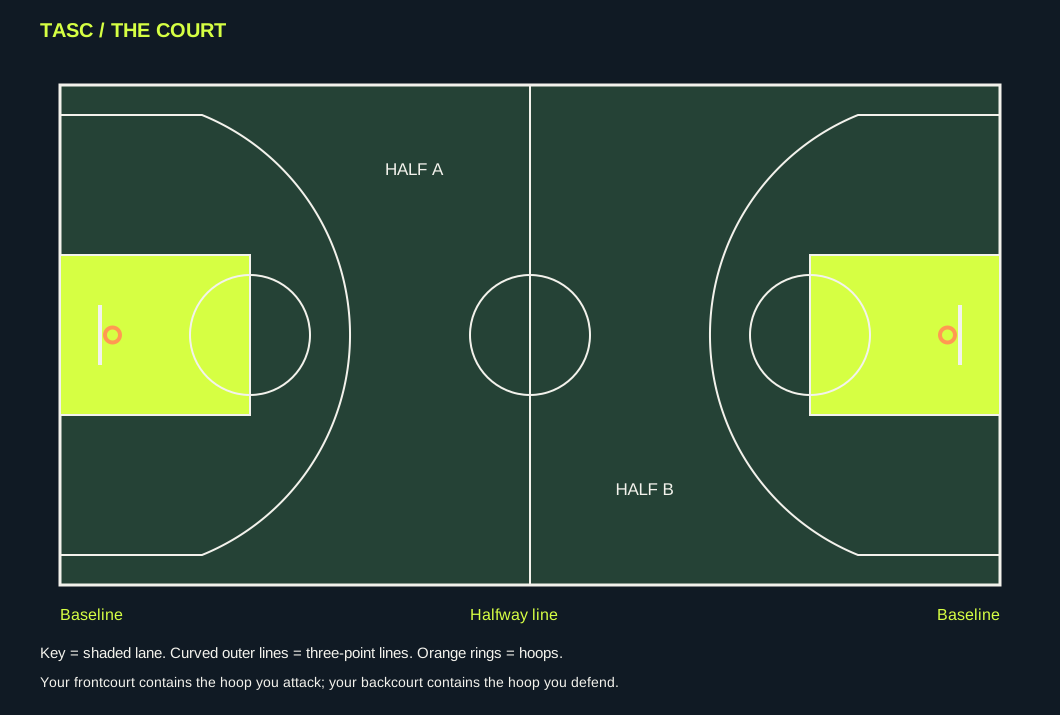
An NBA game is played by two teams of five players on a court. The aim is to score more points than the other team by putting the ball through the opponent’s hoop, which is 10 feet above the floor.
Teams move the ball by passing or dribbling—bouncing it on the floor while moving. They can score from close to the basket, from mid-range, or from behind the three-point line. The other team tries to stop them, win the ball and score at the opposite end.
3. How do the game clock and shot clock work?
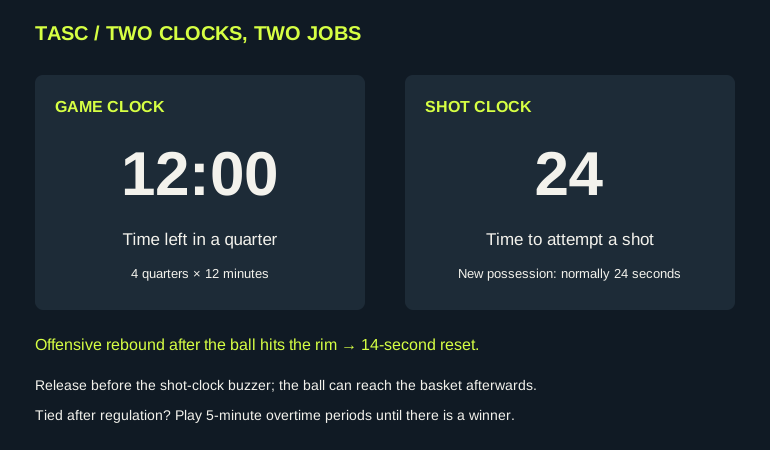
An NBA game has four 12-minute quarters, giving 48 minutes of playing time. The clock stops for whistles and certain other situations, so a game broadcast usually lasts much longer than 48 minutes.
A new possession normally starts with a 24-second shot clock. The ball must leave the shooter’s hand before it expires, then enter the basket or touch the rim. It can still be in the air when the buzzer sounds. A late release, or a shot that misses without touching the rim, normally gives possession to the opposition; officials need not stop play if the defence immediately gains clear control after an airball. When the attacking team gets the ball back after a missed shot that hits the rim, the shot clock usually resets to 14 seconds.
If the score is tied at the end of the fourth quarter, the teams play a five-minute overtime period. They play further overtime periods if the score is still tied.
4. How do teams score?
The number of points depends on the type and location of the shot:
- Two points: A successful shot taken inside the three-point line.
- Three points: A successful shot taken from behind the three-point line. The line is 23 feet 9 inches from the basket at the top of the arc and 22 feet away in the corners.
- One point: A successful free throw, taken without a defender contesting the shot from the free-throw line.
Free throws are awarded in specific situations, often when a player is fouled while shooting. If the player makes the shot despite the foul, the basket counts and they may be awarded one additional free throw. This is commonly called an and-one.
5. How do teams gain and lose possession?
Each team’s turn attacking is called a possession. Possession changes in several ways:
- After a made basket: The other team takes the ball and passes it in from behind the baseline, the boundary line behind the basket.
- After a defensive rebound: If a shot misses and the defending team catches the ball, it takes possession.
- After a steal: A defender takes the ball from a dribbler or intercepts a pass.
- After a turnover: The other team gets the ball when a team loses it through a violation, an intercepted or misplaced pass, or an offensive foul.
If the attacking team misses but grabs the rebound, that is an offensive rebound and it keeps possession. If the missed shot touched the rim, the shot clock resets to 14 seconds. If it missed the rim, an offensive rebound does not reset it. If the defending team grabs the rebound, it is a defensive rebound and possession changes.
The game begins with a jump ball: the referee tosses the ball up between two opposing players at centre court, and they try to tap it to a teammate. Jump balls can also decide possession during play, including when opponents have the ball tied up.
6. What are the positions and player roles?
Basketball traditionally describes five positions, often numbered from 1 to 5. Modern players can take on several roles, so these are useful guideposts rather than strict job descriptions. The perimeter means the outer area of the attack, around the three-point line.
- Point guard (1): Often brings the ball up the court, organises the attack and creates chances for teammates.
- Shooting guard (2): Often looks for scoring chances, including from long range, and defends opposing guards.
- Small forward (3): A versatile player who may score, rebound and defend several positions.
- Power forward (4): Often contributes near the basket and on the perimeter, including rebounding and shooting.
- Center (5): Often plays near the basket, protecting the rim, rebounding and scoring close to the hoop.
You may also hear role descriptions such as “rim protector” for a player who helps defend the basket, or “3-and-D” for someone valued for three-point shooting and perimeter defence.
7. What are the main fouls and violations?
A violation is a breach of a playing rule. A foul usually involves illegal contact or unsportsmanlike behaviour. Both stop play, but their penalties differ.
Common violations
- Travelling: Illegal movement while holding the ball, such as taking too many steps after gathering it or moving the pivot foot incorrectly.
- Double dribble: Starting to dribble again after ending a dribble, or dribbling with both hands at the same time.
- Out of bounds: The ball touches the boundary line, the floor outside it, or a player who is out of bounds. A player touching the line or floor outside it is out of bounds too.
- Backcourt violation: The frontcourt is the half containing the basket a team is attacking; its backcourt contains the basket it defends. Once the team establishes control in the frontcourt, it generally cannot send the ball back and touch it first in the backcourt.
- Three-second violation: An offensive player generally cannot remain in the opponent’s key—the rectangular free-throw lane beneath the basket—for more than three seconds while their team controls the ball in the frontcourt. There are allowances, such as when the player is leaving the lane or moving into a shot.
- Five-second violation: A player taking a throw-in must release the ball within five seconds. The NBA has a separate five-second restriction on dribbling with the back or side to the basket in a specified area; it is not a general closely guarded holding rule.
- Eight-second violation: A team must move the ball from its backcourt into the frontcourt within eight seconds.
- Shot-clock violation: The team fails to release a qualifying shot before its allotted time expires. A shot released in time may reach the rim or go in after the buzzer.
Most violations give the ball to the other team for a throw-in.
Personal fouls
A personal foul is illegal contact with an opponent. Examples include holding, pushing or making illegal contact with a shooter. The penalty depends on the situation: the fouled team may get the ball for a throw-in or be awarded free throws. A player is normally disqualified after committing six personal fouls.
Some common foul terms are:
- Shooting foul: Illegal contact on a player attempting a shot. If the shot misses, the player usually gets two or three free throws, depending on the shot. If it goes in, the basket counts and the player usually gets one free throw.
- Blocking foul: A defensive foul for illegally impeding an opponent’s movement.
- Charging foul: An offensive foul for illegally running into a defender who has established a legal guarding position.
- Loose-ball foul: Illegal contact while neither team has clear possession, often while players are competing for a rebound.
- Team-foul penalty (the bonus): After a team reaches the foul limit in a quarter, certain defensive fouls can result in free throws. The details depend on the type of foul and when it occurs.
Technical and flagrant fouls
- Technical foul: A penalty for certain unsportsmanlike actions or rule breaches that do not involve ordinary play contact. The other team is generally awarded a free throw; possession is administered according to the situation. A player who receives two unsportsmanlike technical fouls in a game is ejected.
- Flagrant foul: Unnecessary or excessive contact. A Flagrant 1 is unnecessary contact; a Flagrant 2 is unnecessary and excessive contact and results in an ejection. Both carry free throws and possession for the offended team.
8. How does the NBA season and playoff system work?
The NBA season runs from the regular season through the playoffs and Finals. The exact dates vary from year to year.
Regular season
Each team plays 82 regular-season games, generally from autumn into spring. Teams build a win-loss record within their conference, which determines their position, or seed, going into the postseason.
The NBA Cup
The NBA Cup is a midseason competition. Its final sits outside regular-season standings. Winning it is separate from winning the NBA Finals.
Play-In Tournament
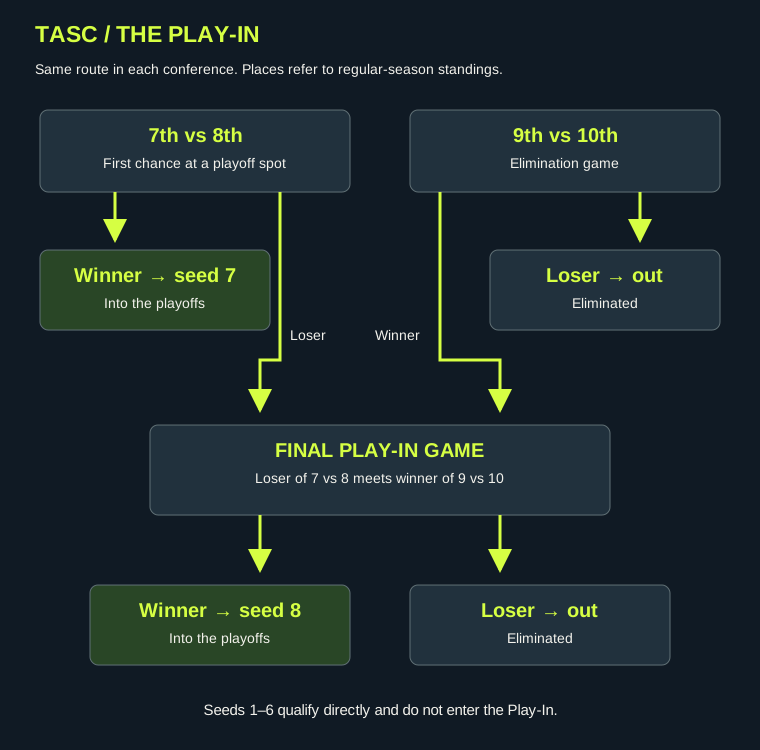
The top six teams in each conference qualify directly for the playoffs. Teams finishing seventh to tenth enter the Play-In Tournament, which decides the seventh and eighth seeds:
- The seventh-place team plays the eighth-place team. The winner earns the seventh seed; the loser gets another chance.
- The ninth-place team plays the tenth-place team. The loser is eliminated; the winner advances.
- The winner of the ninth-versus-tenth game plays the loser of the seventh-versus-eighth game. The winner earns the eighth seed.
NBA Playoffs and Finals
Eight teams from each conference enter the playoffs. In the first round, the matchups are first versus eighth, second versus seventh, third versus sixth, and fourth versus fifth. Teams play opponents from their own conference until a conference champion is decided.
Each playoff round is a best-of-seven series: the first team to win four games advances, and the other team is eliminated. The Eastern Conference champion then faces the Western Conference champion in the NBA Finals, also a best-of-seven series. The winner lifts the Larry O’Brien Championship Trophy.
9. How can a new fan start following the NBA?
You do not need to watch all 82 games or learn every rule at once. Here are a few easy ways to get started:
- Pick a team or player to follow. You might choose a team because of its city, history, players or style of play. You can also watch a few games before deciding.
- Watch a game or highlights. Pay attention to how teams move the ball, create shots and defend. Highlights and game recaps can help you learn the players and main storylines.
- Follow scores and standings. The NBA’s official app and website provide schedules, results, team standings and statistics.
- Explore the wider basketball conversation. Podcasts, social media and fan communities can add context and entertainment. Streaming and broadcast options vary by country and season, so check what is available where you live.
You will pick up more of the rules as you watch. Start with the score, the shot clock and which team has possession; the rest will become easier to follow over time.
Conclusion
Basketball can look complicated at first because the action moves quickly, but the basic idea is simple: two teams take turns trying to score, while the clock, shot clock and rules shape each possession. Once you understand those pieces, it becomes much easier to follow the game and enjoy the skill, teamwork and rivalries that make the NBA compelling.
Thanks for reading this TASC 101 guide. Keep watching, keep learning, and Stay on TASC.
Sources and further reading
- NBA Official Playing Rules — the main rules reference.
- Rule 7: Shot Clock — shot release, rim contact and clock resets.
- Rule 8: Out-of-Bounds and Throw-In — boundary lines, inbounding and possession after scores.
- Rule 10: Violations and Penalties — travelling, dribbling, three-second, five-second and backcourt rules.
- NBA Play-In Tournament format and FAQ — how the final playoff places are decided.
- NBA Cup: Frequently Asked Questions — the Cup and its relationship to the regular season.
Editorial note: This guide explains NBA basketball. Other competitions can use different rules. The explanations simplify unusual situations and exceptions.
Original TASC diagrams. Rules overview checked 21 October 2026.
EXPLORE NFL 101 ↗