
Introduction
Let’s be honest: ice hockey gives you plenty to take in. The puck moves quickly, players jump on and off the ice while the game is still going, and just as an attack gets going, a whistle can bring everything to a halt. Where do you even start?
That is what I want to help with in this guide. We will work through what the NHL is, how the game works and what those whistles actually mean, so you can put a game on and follow the action with a bit more confidence. There is speed, skill and plenty of physical contact, but you do not need to memorise a rulebook to enjoy it.
The basic idea is straightforward: two teams try to shoot a puck into the other team’s net while protecting their own. Let’s build from there.
1. What is the NHL?
The NHL is the National Hockey League, the leading professional ice hockey league in North America. It was founded in 1917 and currently has 32 teams: 25 in the United States and seven in Canada. The teams are split between the Eastern and Western Conferences, with each conference containing two divisions: Atlantic and Metropolitan in the East; Central and Pacific in the West. Every team is competing for the same prize: the Stanley Cup.
The NHL is one league, but the divisions and conferences help organise the regular-season schedule and the route into the playoffs. You will often see a team described by its conference or division when commentators discuss the standings.
2. How does ice hockey work?
The aim is to score more goals than the other team. Players use their sticks to pass, carry and shoot a hard rubber disc called a puck. A goal is scored when the whole puck crosses the goal line and enters the net, provided the goal is legal.
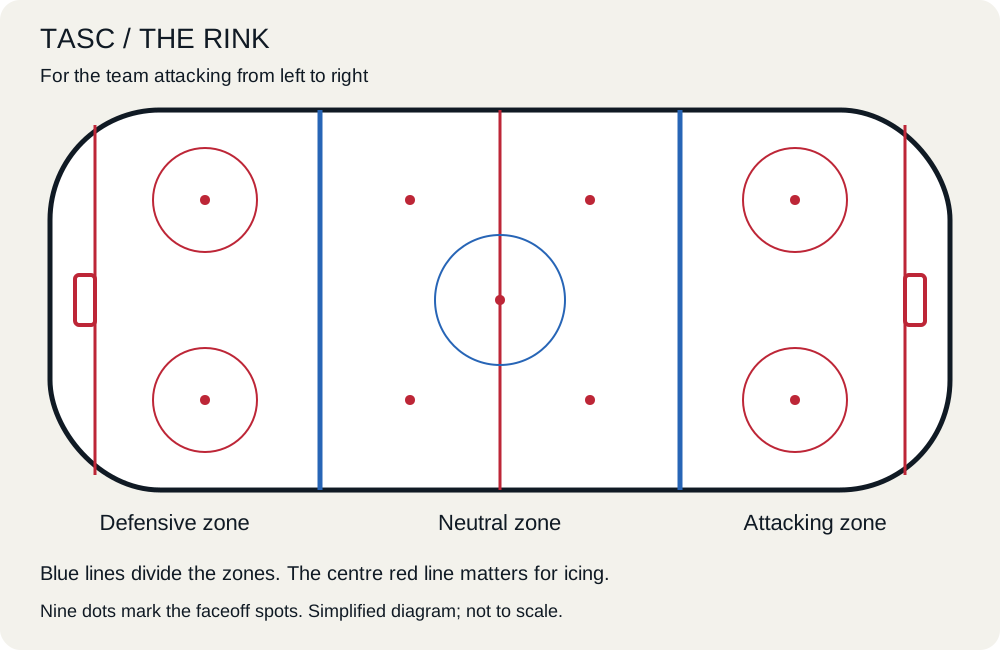
At full strength, each team has six players on the ice: five skaters and a goaltender. The rink is divided by red and blue lines into three main areas:
- Defensive zone: the area containing your team’s own goal.
- Neutral zone: the middle section of the rink.
- Attacking zone: the area containing the goal your team is trying to score in.
Teams switch which end they attack between periods. The blue lines matter because they help determine whether a team has entered the attacking zone legally. The red line across the middle is also used in rules such as icing.
Hockey is played in short bursts. Players skate hard for a shift, often lasting less than a minute, then change with teammates. These substitutions can happen while play continues, provided the players leave and enter the ice correctly. That is why the players on the rink are constantly changing.
How does the game clock work?
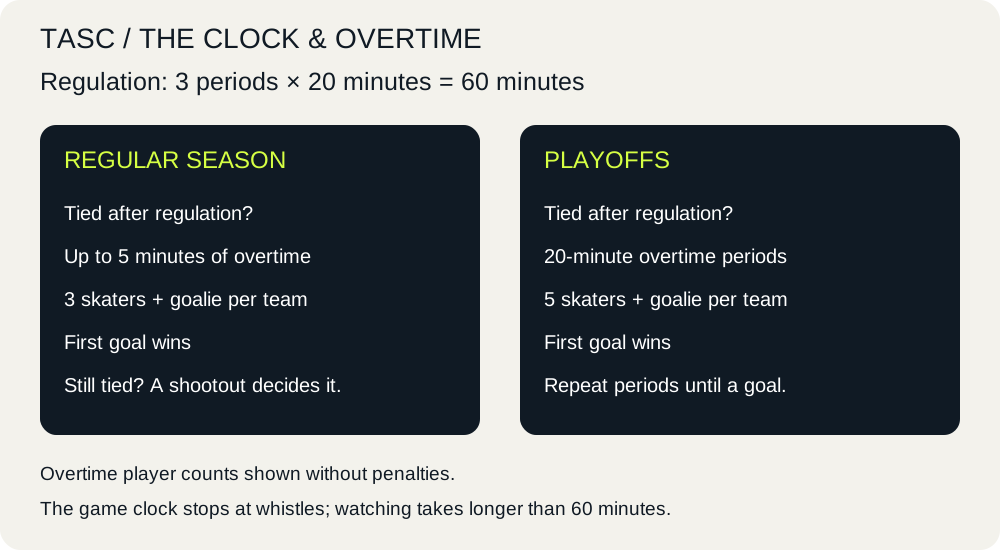
An NHL game has three periods of 20 minutes, giving 60 minutes of official playing time. The clock counts down and stops for many whistles, including goals, penalties and the puck leaving play. There are two intermissions between the periods, during which the ice is resurfaced.
So a game takes much longer than an hour to watch from start to finish. Stoppages, intermissions and video reviews all add time.
If the score is tied after regulation in a regular-season game, the teams play a five-minute sudden-death overtime with three skaters and a goaltender on each side. Sudden death means the first goal wins. If nobody scores, the game goes to a shootout: players take turns skating in alone against the opposing goaltender, and the team with more successful attempts wins.
The playoffs use a different overtime format. If a playoff game is tied after regulation, teams play additional 20-minute periods at five-on-five. The first goal ends the game, and another period is played if necessary. There are no shootouts in the playoffs.
3. What are offsides, icing and faceoffs?
These rules explain many of the whistles a new viewer will see.
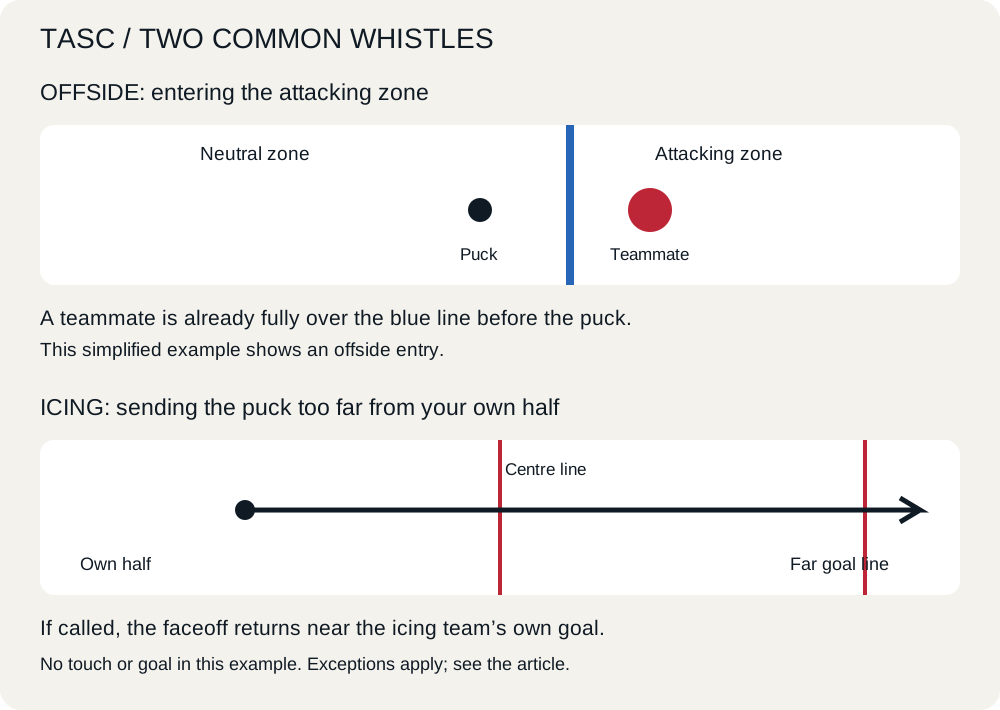
Offside is about entering the attacking zone. The puck must cross the attacking team’s blue line before its skaters do. If a teammate enters the zone too early, the officials stop the play or signal a delayed offside. The attacking players can clear the zone and re-enter properly to get play moving again.
Icing usually happens when a team sends the puck from its own side of the centre red line beyond the opposing goal line without it being touched or entering the net. If icing is called, play stops and the faceoff comes back to one of the faceoff spots in the defensive zone of the team that sent the puck down the rink. That puts the restart near its own goal. The team responsible normally cannot change players before that faceoff, so icing is not a free chance to replace tired skaters. It is a stoppage rather than a penalty, and there are exceptions: a team that is shorthanded because of a penalty can generally ice the puck without a call.
A faceoff restarts play after a stoppage. An official drops the puck between two opposing players, who try to win possession for their team. Linespeople conduct most faceoffs. Faceoffs take place at one of the nine marked faceoff spots around the rink, with the location depending on why play stopped and where it happened.
4. How do teams score?
A goal counts as one point on the scoreboard. The player who last touched the puck for the scoring team is credited with the goal. Up to two teammates who touched the puck before the scorer can be credited with assists. That is why a player’s statistics often show goals, assists and total points.
You will also hear commentators describe the situation in which a goal was scored:
- A power-play goal is scored while the other team has a player serving a penalty and is short-handed.
- A shorthanded goal is scored by the team that is short-handed.
- An empty-net goal is scored when a team has removed its goaltender to put an extra skater on the ice, usually while chasing a late equaliser.
The score can look low compared with basketball or American football, but that is part of hockey’s appeal: a single goal can change the whole game.
5. Who does what on the ice?
The five skaters are usually arranged as three forwards and two defencemen, alongside the goaltender.
- Centre: plays through the middle, takes many faceoffs and often supports both the attack and defence.
- Left wing and right wing: play on either side of the centre. They help create scoring chances and defend the sides of the rink.
- Defencemen: work mainly in front of their own goal, break up attacks and help move the puck forward.
- Goaltender (goalie): protects the net and tries to stop shots. Goalies wear extra protective equipment and have special rules that apply to them.
These are general roles, not fixed boundaries. Forwards help defend, defencemen can join an attack, and the goalie can play the puck in some situations. Coaches also change lines regularly to keep players fresh.
6. What happens when a player breaks the rules?
Why are some collisions allowed?
Physical contact is part of NHL hockey. A body check uses the body to challenge an opponent carrying the puck and try to separate them from it. A hard hit can be legal, but its timing, point of contact and the opponent’s position all matter. Checking someone who is not eligible to be hit can be interference; dangerous hits can lead to penalties for boarding, charging, checking from behind or an illegal check to the head. The size of the collision alone does not tell you whether it is legal.
Penalties and power plays
A referee can call a penalty for actions such as tripping, hooking, slashing, holding or interfering with an opponent. The player may have to sit in the penalty box, leaving their team with fewer skaters for a period of time.
The most common penalty a beginner needs to recognise is a minor penalty, which usually lasts two minutes. The team with the extra skater has a power play; the team with fewer skaters is on the penalty kill. If the power-play team scores during a standard minor penalty, that penalty normally ends early. Some penalties work differently, so not every penalty ends when a goal is scored.
A major penalty is more serious and usually lasts five minutes. The penalised team remains short-handed even if it concedes a goal during that time.
Sometimes the referee raises an arm to signal a delayed penalty. Play continues while the non-offending team has possession, allowing it to keep attacking. Once the offending team gains possession and control of the puck, the referee stops play and deals with the penalty; a brief deflection or rebound alone does not normally end the delayed call. The attacking team can also pull its goalie for an extra skater during this passage of play. If it scores or another stoppage occurs first, play ends then, with the penalty handled according to the applicable rules.
A penalty shot is awarded in specific situations when a foul takes away a clear scoring opportunity. One attacker gets a one-on-one attempt against the goalie. It is a special ruling, not the result of every penalty.
7. How does the NHL season work?
A season includes preseason games, the regular season and the Stanley Cup Playoffs. Preseason games let teams prepare and evaluate players before the standings begin to count.
The regular-season schedule has changed for 2026–27: each team plays 84 games, up from 82 in recent seasons. Teams earn standings points as they chase a playoff place. A win is worth two points; a loss in overtime or a shootout is worth one; a loss in regulation is worth none. This is why a team’s record is often shown in three numbers, such as wins, regulation losses and overtime or shootout losses.
Sixteen teams qualify for the Stanley Cup Playoffs. The top three teams in each of the four divisions take 12 places. The remaining four places go to the next two highest-placed teams in each conference, regardless of division; these are the wild cards. Each playoff round is a best-of-seven series, so the first team to win four games advances. The two teams that win their conference finals meet in the Stanley Cup Final.
Teams that do not make the playoffs move into the offseason. That is when clubs can draft young players, trade players and sign free agents as they build for the next campaign.
8. How can you start following the NHL?
For your first game, focus on a few things rather than trying to learn everything at once:
- Watch which team has the puck and which team is defending.
- Notice the blue lines when a team enters the attacking zone.
- Look for line changes and see how quickly fresh players come on.
- Pay attention when a penalty creates a power play.
- Watch the clock and scoreboard late in a close game.
If you want a team to follow, choose one whose style, players, location or story interests you. You can check the NHL schedule, scores, standings and video rulebook on NHL.com. Learning a handful of players’ names also makes it easier to follow the action and understand the commentary.
9. How can you get into the NHL as a UK fan?
You do not need to stay up every night or commit to a team straight away. Start with a few highlights, try a weekend game and see which players or teams make you want to watch again.
Where can you watch NHL games in the UK?
Premier Sports carries a selection of live NHL games in the UK, including playoff coverage. Check its current listings to see which games are being shown.
NHL.TV on DAZN offers a separate subscription for live games and on-demand viewing. A standard DAZN subscription is not required to buy NHL.TV. Selected games shown by Premier Sports are blacked out live on NHL.TV in the UK; DAZN says full-length replays become available shortly after those broadcasts end. Check the current restrictions before subscribing if following one particular team is your priority.
Free-to-air coverage: ITV4 and ITVX carried selected games during 2025–26. Check their current listings before relying on them for this season; that earlier deal does not by itself confirm a regular 2026–27 schedule.
How do you manage the late starts?
A 7pm start in the Eastern time zone is normally midnight in the UK. A 7pm start on the Pacific coast is normally 3am here. The difference briefly changes when UK and North American clocks move on different dates, so check each fixture in UK local time.
Weekend afternoon games in North America can land in the UK afternoon or evening. Look out for the NHL Saturday and NHL Sunday viewing windows rather than assuming every game means a late night.
Replays, condensed games and official highlights are useful alternatives. Start with a short recap, then try a full game when you have time. Highlight titles, thumbnails and scoreboards can reveal the result, so do not assume they are spoiler-free.
How do you choose a team?
Let the team earn your interest. You might connect with a player, a city, a club’s history or simply the way it plays. Watch a few different teams before deciding.
If watching live matters most, Eastern time zone teams such as the Boston Bruins, New York Rangers, Toronto Maple Leafs and Detroit Red Wings usually have more manageable home start times than Pacific coast clubs. Midnight is still late, though, and road games change the picture. You can absolutely follow the Los Angeles Kings, Vancouver Canucks or San Jose Sharks through replays and highlights if one of them catches your eye.
Try watching hockey closer to home
Seeing hockey in person helps you appreciate the speed, line changes and movement away from the puck. The UK’s Elite Ice Hockey League offers a way to experience that atmosphere without travelling to North America.
Clubs include the Belfast Giants, Sheffield Steelers, Cardiff Devils and Glasgow Clan. For readers around Glasgow, a Clan home game in Braehead is an accessible place to start. Check fixtures and ticket availability, watch how players position themselves, and enjoy the atmosphere. Domestic hockey has its own clubs, rivalries and appeal, so it can become part of your sporting routine alongside the NHL.
My suggestion: watch a few highlights this week, choose one UK-friendly weekend fixture and give it a full game. You do not need to understand every whistle on day one.
Conclusion
Ice hockey can seem hectic at first, but the essentials are simple: get the puck into the other team’s net, defend your own, and use your five skaters and goalie well. The clock, line changes, blue lines and penalties explain most of the stops and shifts you will see. Once those pieces click, you can start enjoying the speed, skill and drama without needing to know every rule. Pick a game, follow the puck and see which team catches your eye.
Stay on TASC.
Sources and further reading
- About the NHL
- 2026–27 regular-season schedule
- NHL official rules and video rulebook
- NHL playoff format
- NHL video rulebook: boarding
- NHL video rulebook: charging
- NHL hockey glossary
- Standings explained by the Seattle Kraken